

4.5 权重衰退的代码实现
首先,我们生成一些数据,公式如下: 为了使过拟合的效果更加明显,我们可以将问题的维数增加到 ,并使用一个只包含20个样本的小训练集。
%matplotlib inlineimport torchfrom torch import nnfrom d2l import torch as d2l
n_train, n_test, num_inputs, batch_size = 20, 100, 200, 5true_w, true_b = torch.ones(num_inputs, 1) * 0.01, 0.05train_data = d2l.synthetic_data(true_w, true_b, n_train)train_iter = d2l.load_array(train_data, batch_size)test_data = d2l.synthetic_data(true_w, true_b, n_test)test_iter = d2l.load_array(test_data, batch_size, is_train=False)- 从零开始实现
def init_params(): """初始化模型参数""" w = torch.normal(0, 1, size=(num_inputs, 1), requires_grad=True) b = torch.zeros(1, requires_grad=True) return [w, b]
def l2_penalty(w): """定义L2范数惩罚""" return torch.sum(w.pow(2)) / 2
def train(lambd): """定义训练代码实现""" w, b = init_params() net, loss = lambda X:d2l.linreg(X, w, b), d2l.squared_loss num_epochs, lr = 100, 0.003 animator = d2l.Animator(xlabel='epochs', ylabel='loss', yscale='log', xlim=[5, num_epochs], legend=['train', 'test']) for epoch in range(num_epochs): for X, y in train_iter: # 增加了L2范数惩罚项, # 广播机制使l2_penalty(w)成为一个长度为batch_size的向量 l = loss(net(X), y) + lambd * l2_penalty(w) l.sum().backward() d2l.sgd([w, b], lr, batch_size) if (epoch + 1) % 5 == 0: animator.add(epoch + 1, (d2l.evaluate_loss(net, train_iter, loss), d2l.evaluate_loss(net, test_iter, loss))) print('w的L2范数是:', torch.norm(w).item())我们现在用lambd = 0禁用权重衰减后运行这个代码。 注意,这里训练误差有了减少,但测试误差没有减少, 这意味着出现了严重的过拟合。
train(lambd=0)w的L2范数是: 14.14365291595459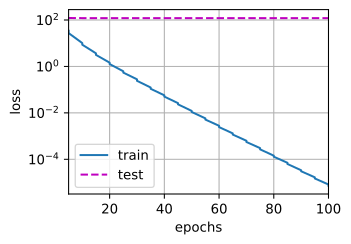
下面,我们使用权重衰减来运行代码。 注意,在这里训练误差增大,但测试误差减小。 这正是我们期望从正则化中得到的效果。
train(lambd=3)w的L2范数是: 0.35196033120155334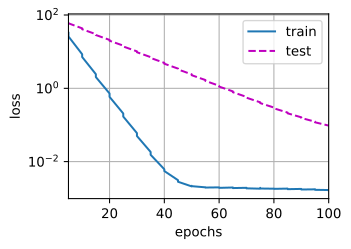
我们接着增大lambd。
train(lambd=10)w的L2范数是: 0.01929609663784504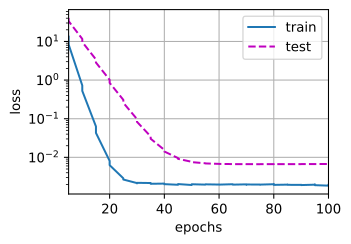
- 简洁实现 由于更新的权重衰减部分仅依赖于每个参数的当前值, 因此优化器必须至少接触每个参数一次。
默认情况下,PyTorch同时衰减权重和偏移。 这里我们只为权重设置了weight_decay,所以偏置参数 不会衰减。
def train_concise(wd): net = nn.Sequential(nn.Linear(num_inputs, 1)) for param in net.parameters(): param.data.normal_() loss = nn.MSELoss(reduction='none') num_epochs, lr=100, 0.003
#这里是最核心的变化 #偏置参数没有衰减 trainer = torch.optim.SGD([ {"params":net[0].weight, "weight_decay": wd}, {"params":net[0].bias}], lr=lr)
animator = d2l.Animator(xlabel='epochs', ylabel='loss', yscale='log', xlim=[5, num_epochs], legend=['train', 'test']) for epoch in range(num_epochs): for X, y in train_iter: trainer.zero_grad() l = loss(net(X), y) l.mean().backward() trainer.step() if (epoch + 1) % 5 == 0: animator.add(epoch + 1, (d2l.evaluate_loss(net, train_iter, loss), d2l.evaluate_loss(net, test_iter, loss))) print('w的L2范数:', net[0].weight.norm().item())train_concise(0)w的L2范数: 15.155548095703125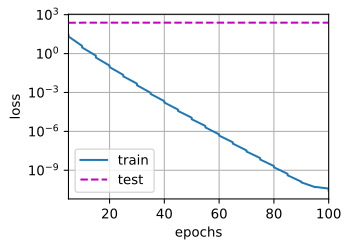
train_concise(3)w的L2范数: 0.3790607154369354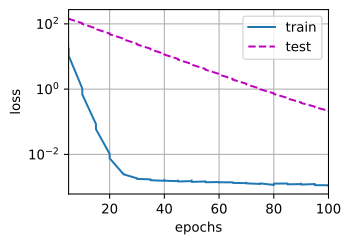
train_concise(10)w的L2范数: 0.026397312059998512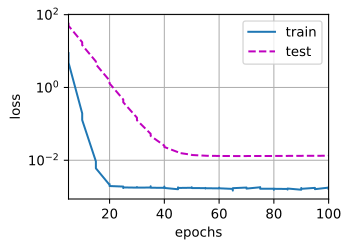
本文由 kaikaikk 原创,发布于
;
转载请保留原文链接:
https://kaikaikk.com/posts/d2l-4-5-weight-decay/